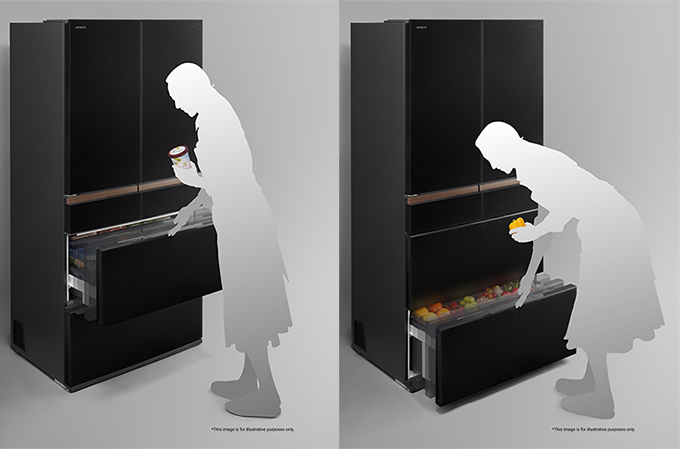
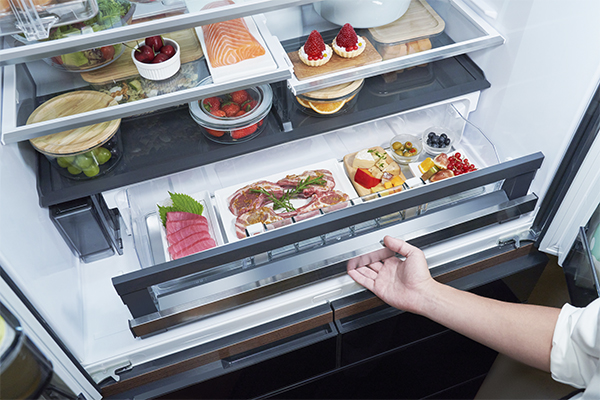
A light press opens the drawer automatically. Even heavily loaded drawers or the
lowest drawer open with ease.
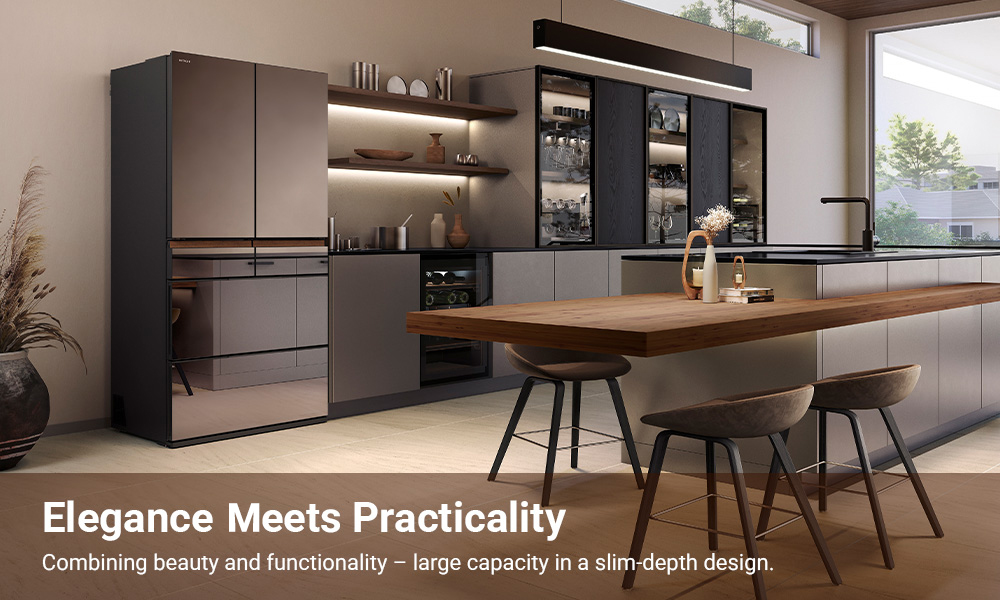
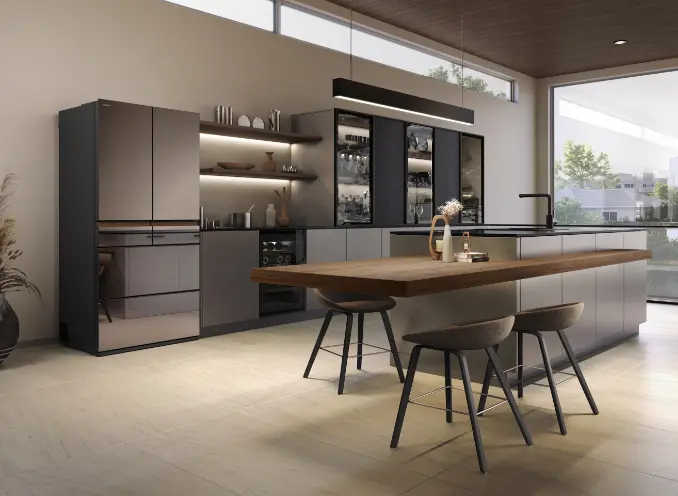
Spacious capacity, slim-depth, and a sleek mirror design
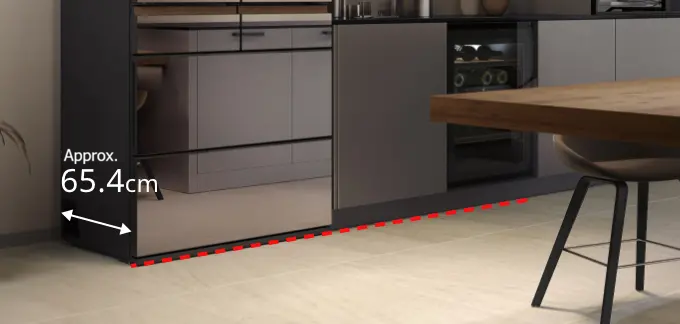
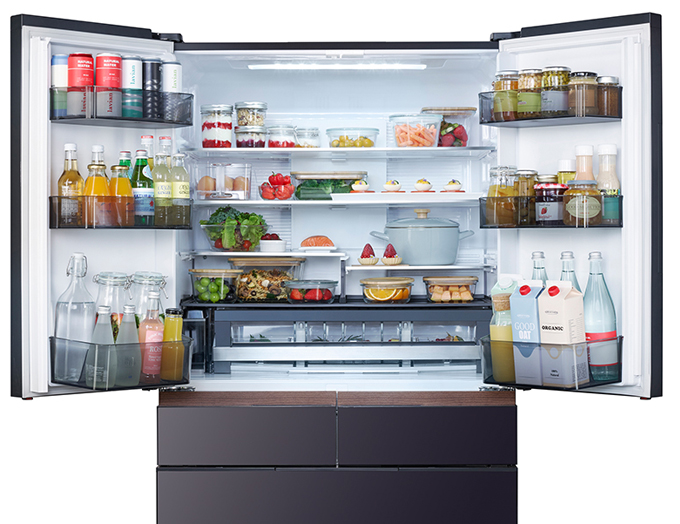
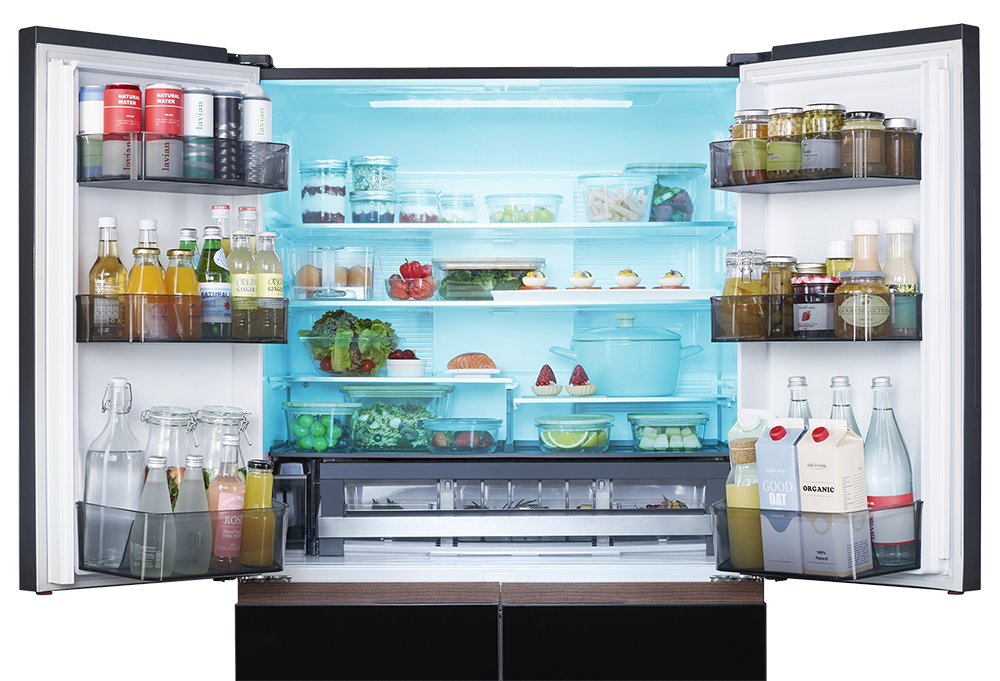
Large capacity 670L (rated), with a slim 65.4cm depth for a clear view to the back and
easy access to stored items. A flat, minimal design with reduced unevenness blends seamlessly into
living spaces. The "Mauve Grey" tone complements contemporary grey-toned kitchens. A stylish glass
finish with a calm mirror expression creates a refined impression. Wood-grain accents on the handles add
a subtle touch of sophistication. The lower freezer and vegetable compartments feature powered drawers
for added ease of use.
Flex & Delicious
Freezing
Easy freezing that preserves taste, with spacious storage.
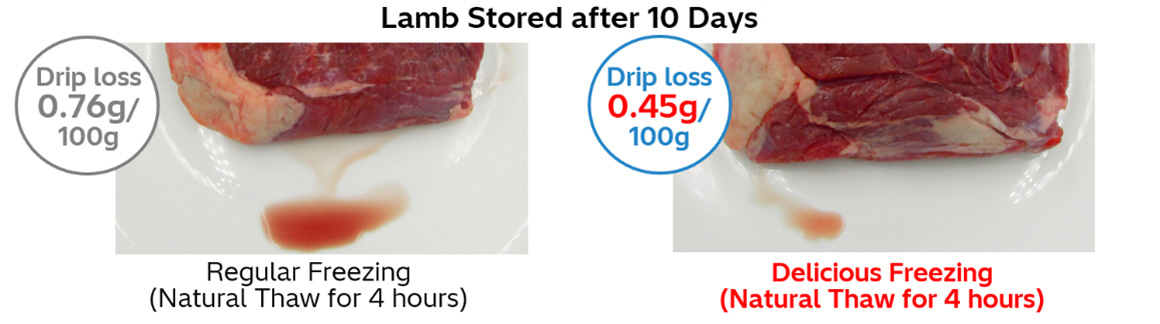
Suppresses the loss of umami during defrosting.
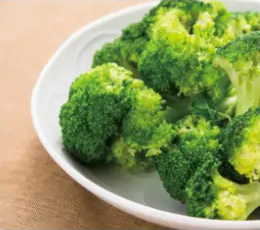
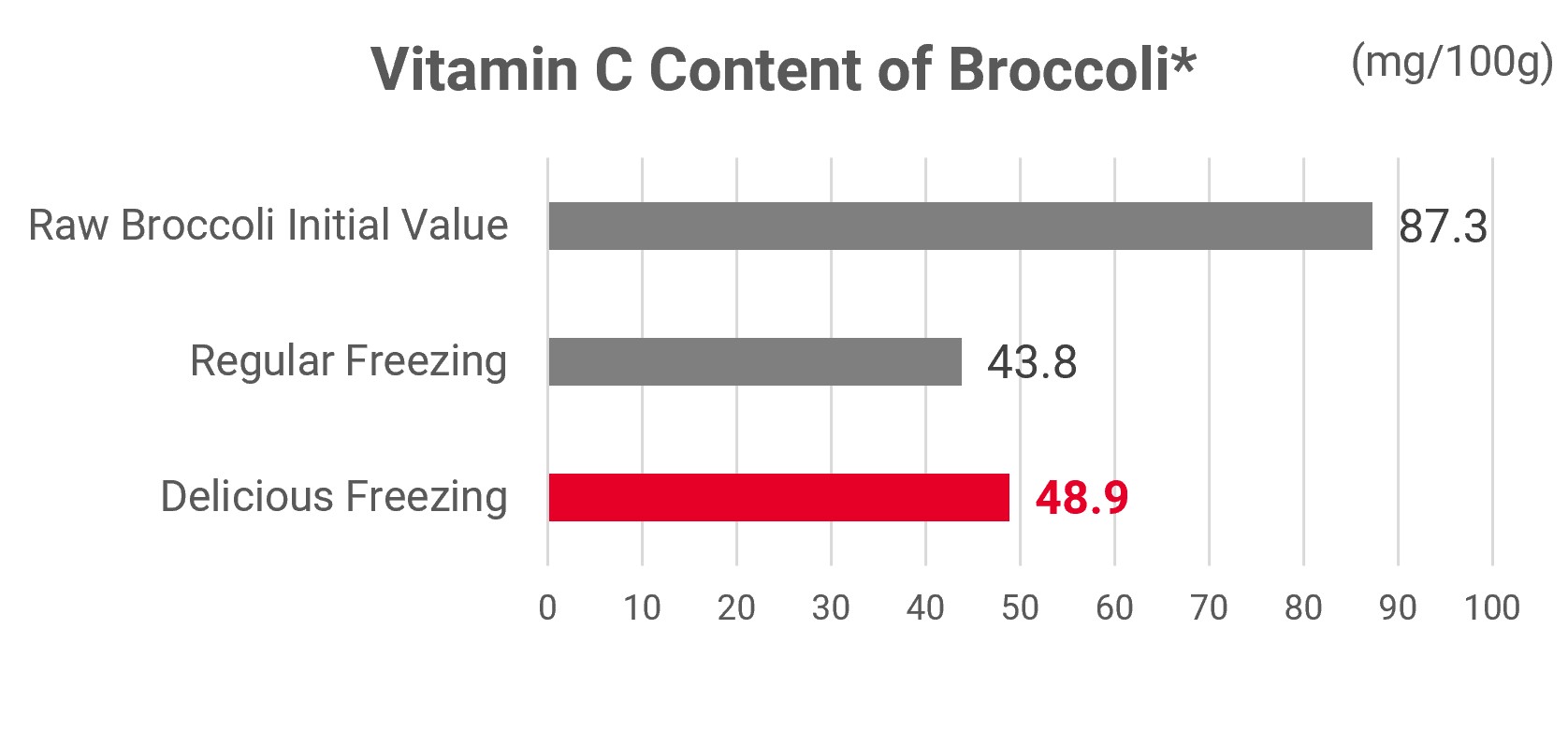
Reduces the loss of vitamin C in vegetables.
※Tested by Hitachi. The effect may differ depending on food types, freshness, packaging
condition.*1
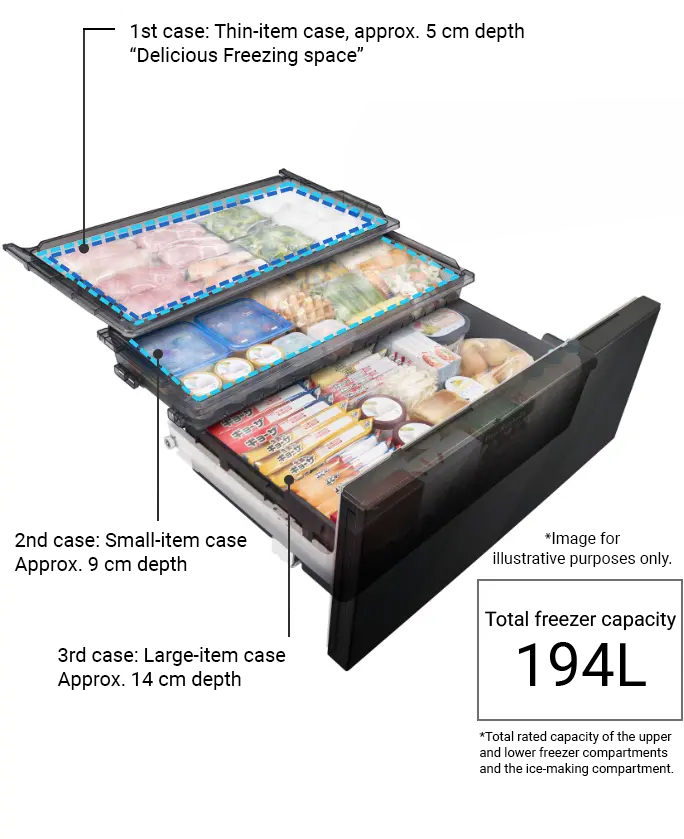
Spacious and easy to organise (1st, 2nd, 3rd cases). Simply place items in—freeze easily and preserve deliciousness
(1st case).
※Tested by Hitachi. The effect may differ depending on food types, condition, and packaging
condition.*1 *2
※If high milk-fat ice cream or similar items are placed in the thin-item case in the upper
or lower freezer compartments,
they may soften. In such cases, please transfer them to the large-item case in the lower freezer
compartment.
*1 Test model: R-GWC670TC (performance equivalent to R-GW670TV). Comparison between the upper tray of the
lower freezer
compartment (Delicious Freezing mode) at Freezer temperature setting ■■ and the middle tray of the lower
freezer
compartment (Regular Freezing mode) at Freezer temperature setting ■■. Test conducted at an ambient
temperature of
approximately 20°C with no door opening or closing. Lamb meat (wrapped) was stored for 10 days and then naturally
thawed
at an ambient temperature of approximately 20°C for 4 hours before comparison. Boiled broccoli was sealed in a bag
and
stored for 10 days before comparison.
*2 Test model: R-GWC670TC (performance equivalent to R-GW670TV). Comparison between the upper tray of the
lower freezer
compartment (Delicious Freezing mode) at Freezer temperature setting ■■ and the middle tray of the lower
freezer
compartment (Regular Freezing mode) at Freezer temperature setting ■■. Test conducted at an ambient
temperature of
approximately 20°C with no door opening or closing. The time required for food to pass through the maximum ice
crystal
formation temperature zone (-1°C to -5°C) was measured. Test food: lamb meat (wrapped). Upper tray: approximately 89
minutes; middle tray: approximately 182 minutes.
Moisture Cooling
*3
※Moisture Cooling is not applicable for door pockets.
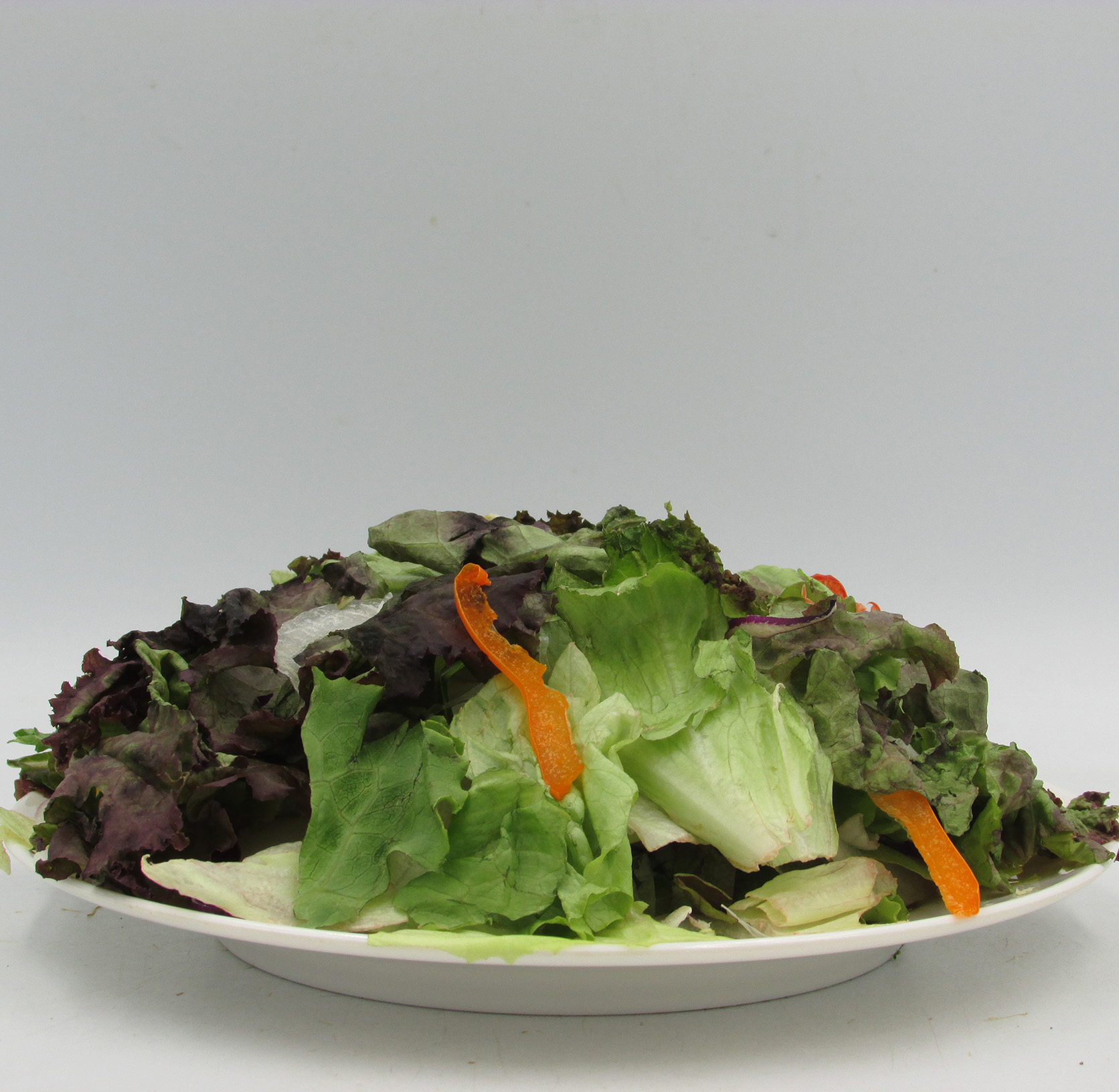
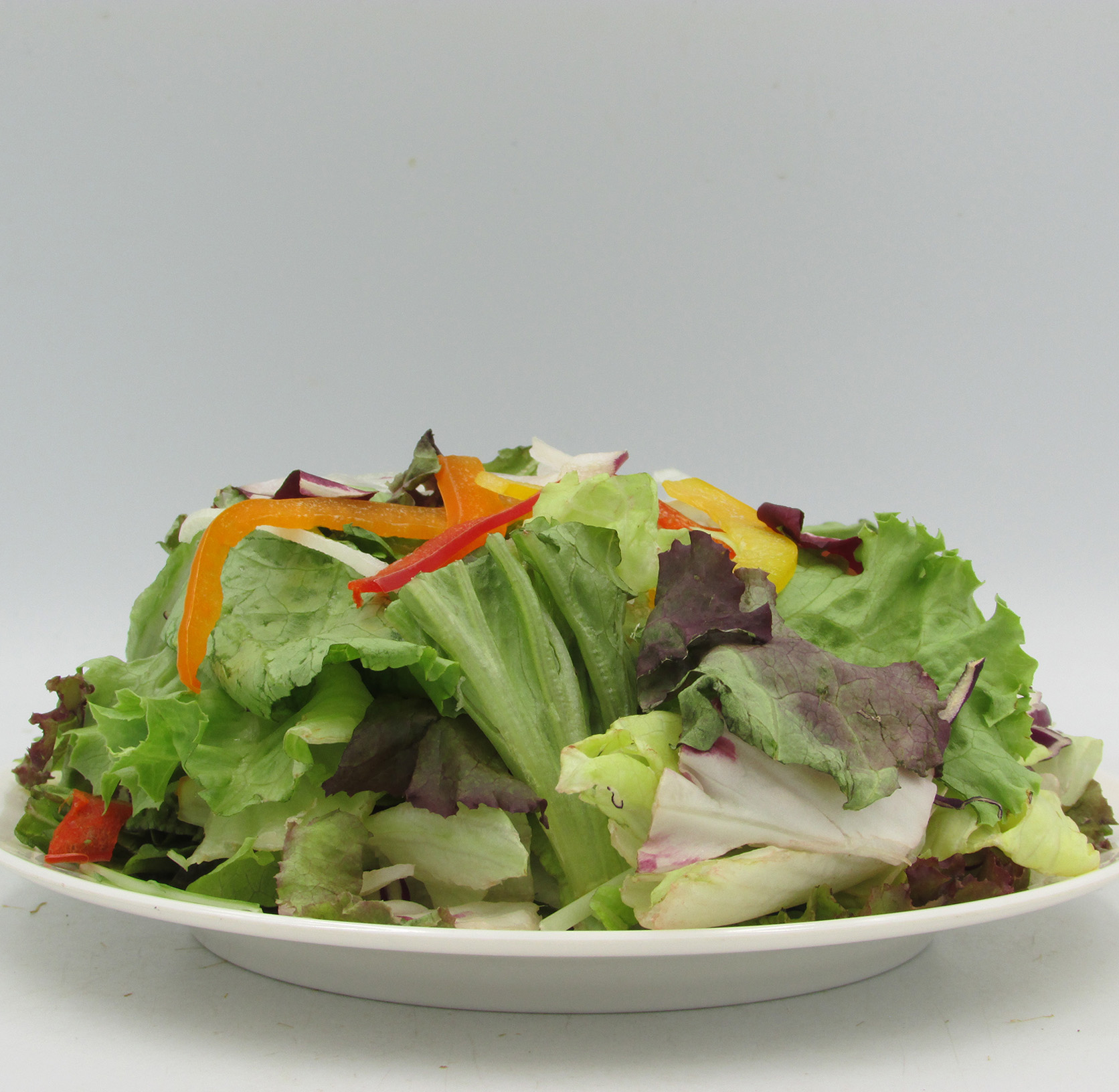
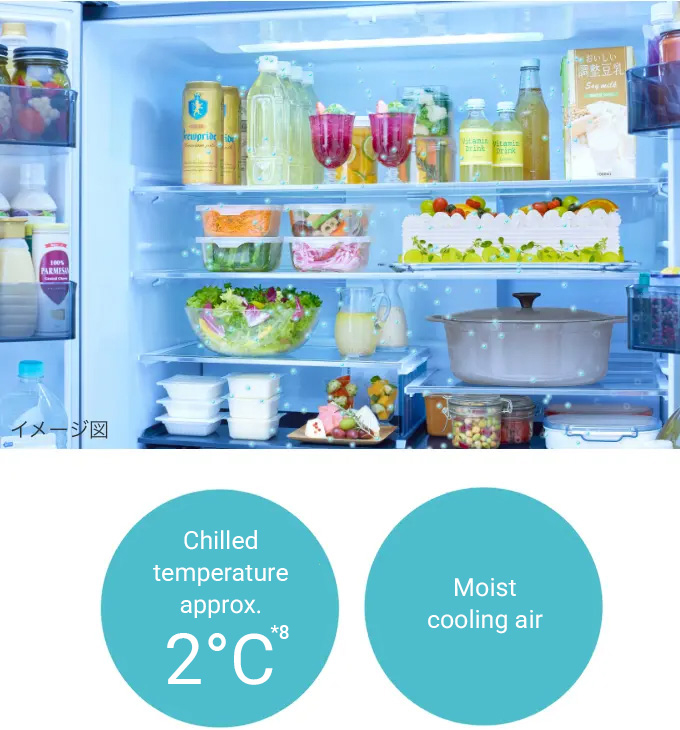
Reduces drying and discolouration, preserving taste.
※Tested by Hitachi. The effect may differ depending on
food types, condition, and quantity.*4,5,6
Leaf Salad Stored after 1 Day
Without Moisture Cooling
With Moisture Cooling
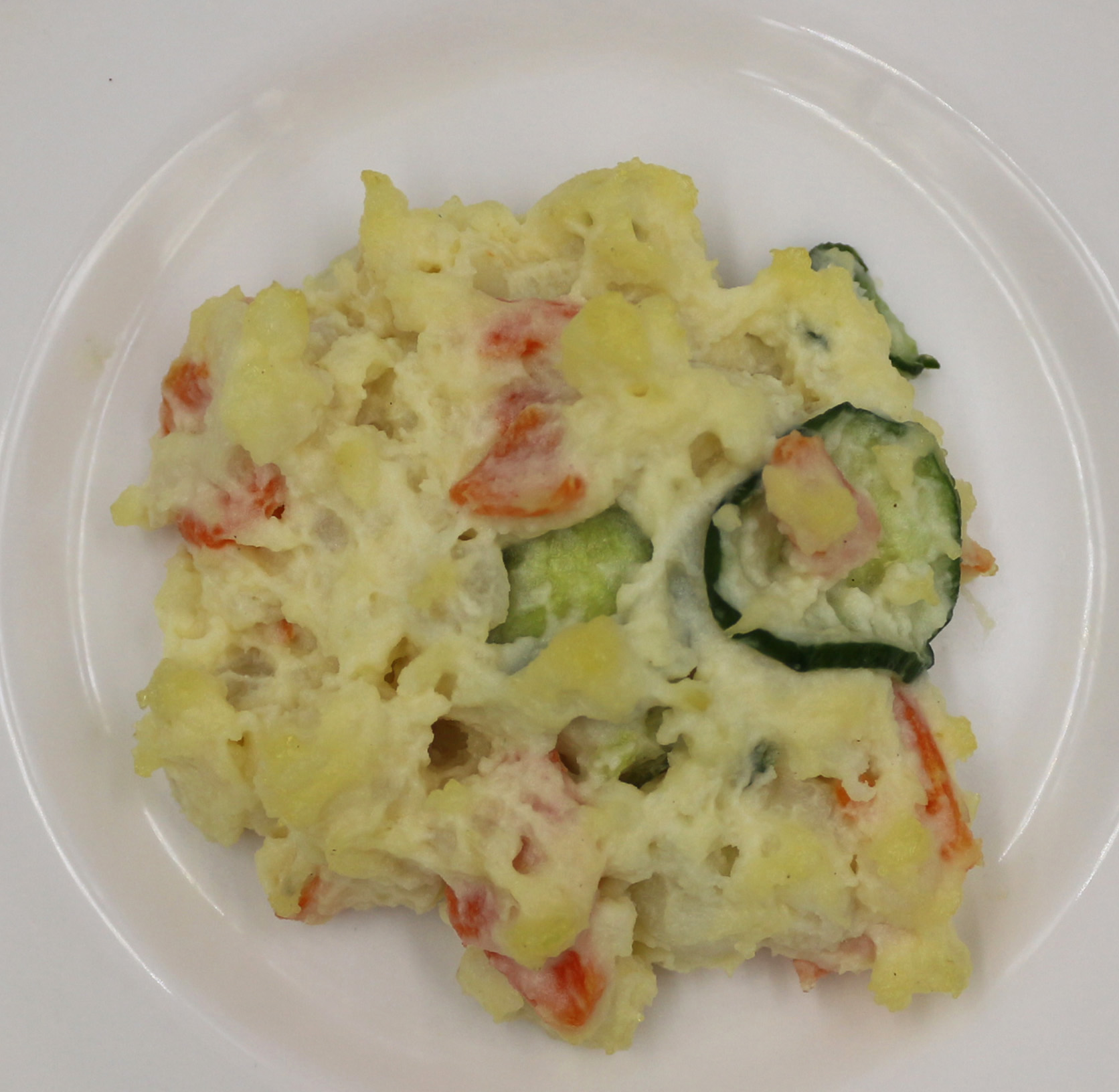
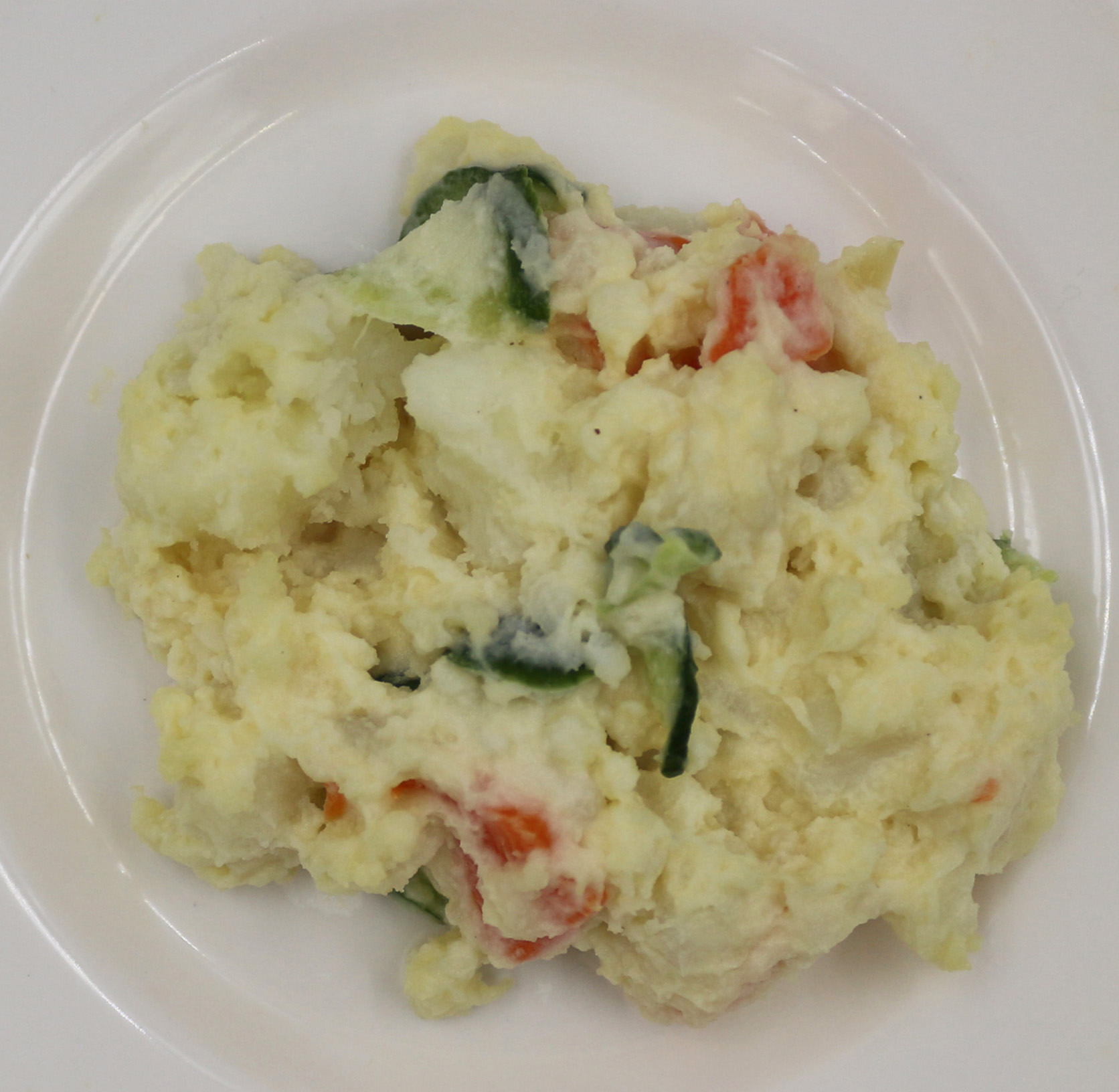
Potato Salad Stored after 1 Day
Without Moisture Cooling
With Moisture Cooling
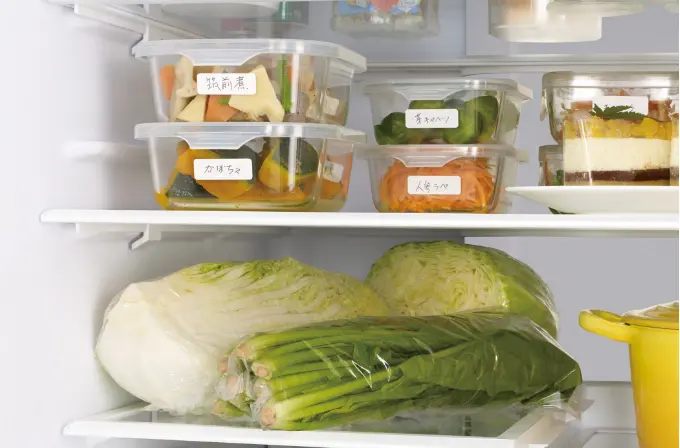
Suitable for
storing leafy vegetables at low temperatures, so when the vegetable
compartment is full, use "Moisture Cooling".
Low temperatures suppress vegetable respiration and help
retain vitamin C.
※Tested by Hitachi. The effect may differ depending on food types, condition, and
quantity.*7
※Image shows model R-HXCC62X (equivalent performance to R-GW670TV).
Capacity, dimensions, and design may vary between
R-HXCC62X and R-GW670TV.
Every shelf in the refrigerator can be used for chilled storage--spacious, easy, and
delicious.
*3 By default, "Moisture Cooling" is on. When activated, the total power consumption is increased by
approx.5%.
*4 Comparison between refrigerator compartment ("Moisture Cooling" on, unwrapped) of R-HXCC62S
(equivalent performance to
R‑GW670TV) and the refrigerator compartment of R-XG56J (without Moisture Cooling, "Spot Powerful Cooling" off,
unwrapped). Room temperature set at approx. 20°C and without door opening/closing. Approx. 400 g (100 g × 4) of leaf
salad was stored for 24 hours. Humidity values show the average humidity around the shelves. The effect may differ
depending on operating conditions and frequency of door opening.
*5 Comparison between refrigerator compartment ("Moisture Cooling" on, unwrapped) of R-HXCC62S
(equivalent performance to
R‑GW670TV) and the refrigerator compartment of R-XG56J (without Moisture Cooling, "Spot Powerful Cooling" off,
unwrapped). Room temperature set at approx. 20°C and without door opening/closing. Potato salad was stored for 24
hours
before comparison.
*6 Foods with strong odours or foods that easily absorb odours should be wrapped.
*7 Comparison between the refrigerator compartment of model R-GXCC67T (equivalent performance to
R-GW670TV) with Moisture
Cooling enabled and no plastic wrap, and the refrigerator compartment of model R-XG56J with Moisture Cooling and
Spot
Powerful Cooling disabled and no plastic wrap. Test conducted at an ambient temperature of approximately 20°C with
no
door opening or closing. Cabbage and Japanese mustard spinach were stored for 7 days before comparison.
Vitamin C retention results:
Cabbage: 45.74 mg retained with Moisture Cooling versus 28.10 mg without Moisture Cooling (initial value: 88.07
mg/100g).
Japanese mustard spinach : 55.68 mg retained with Moisture Cooling versus 45.24 mg without Moisture Cooling
(initial
value: 67.40 mg/100 g).
*8 When the room temperature is approx.32°C and the refrigerator compartment temperature has stabilised
with the "Moisture
Cooling", on.
Vacuum-sealed*9 for Freshness Platinum Catalyst with Ruthenium Vacuum
Compartment
Keeps food fresh without freezing and maintains hydration without the
hassle of wrapping.
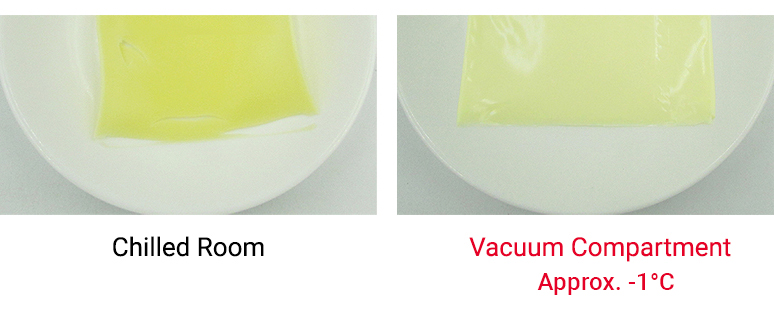
※Tested by Hitachi. The effect may differ depending on
food types, condition, and quantity.*10
Cheese Stored after 3 Days
Sealed storage at approx. 0.8 atm vacuum*9 helps maintain
the freshness of meat and fish longer.
※Tested by Hitachi. Fresh food was used in the test.
※High-moisture foods such as dairy products, cut
vegetables/fruits, and tofu may freeze.
※ Image for illustrative purposes only. The effect may
differ depending on food.
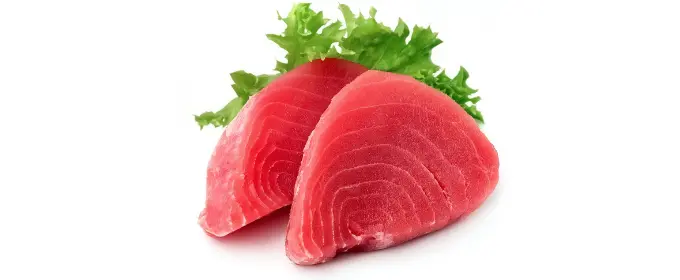
Maintains fish freshness at approx. -1°C
*11 without freezing.
※Tested by Hitachi. K-value evaluated after 3 days. The effect may differ depending on food types,
condition, and quantity.*12
※Image for illustrative purposes only.
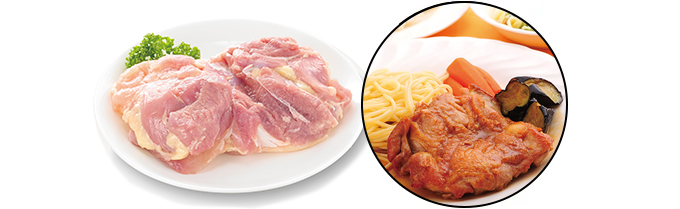
Keeps meat and fish fresh longer,
remaining tasty even after about 7 days when cooked.
※Tested by Hitachi. The effect may differ depending on
food types, condition, and quantity.*12 *13
Chicken Thigh ▶ Chicken Sauté
※Image for illustrative purposes only.
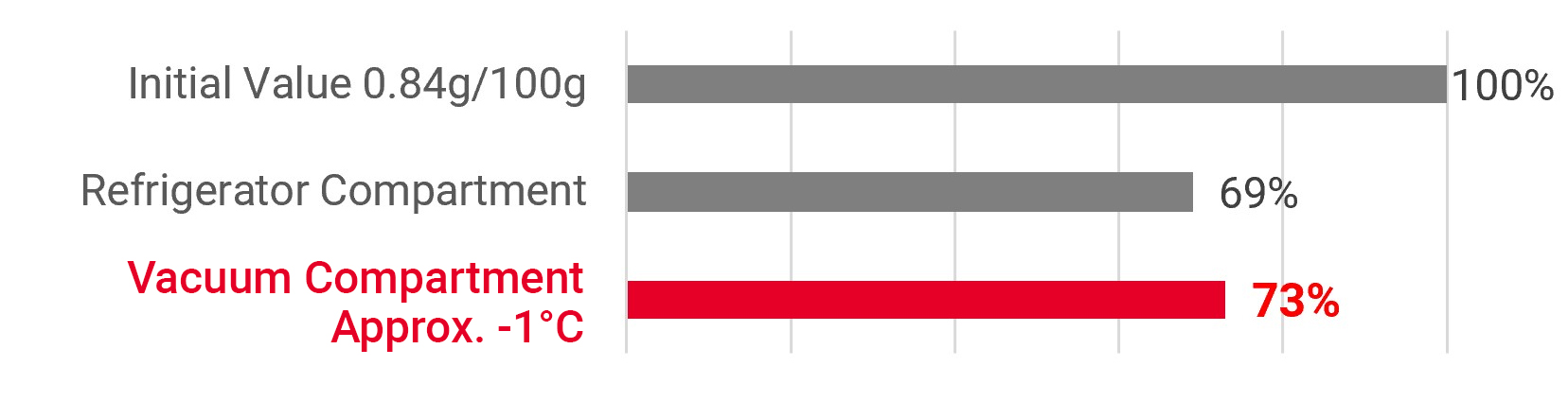
DHA Value in Horse Mackerel Stored after 7 Days
*9 Vacuum is a state of lower pressure than atmospheric pressure. The pressure inside Vacuum Compartment
is approximately
0.8 atmospheres, which is lower than atmospheric pressure, so Hitachi calls it a vacuum. This value represents the
average pressure inside the compartment when operated for 3 days without opening or closing the door.
*10 Comparison of storage for 3 days between Vacuum Compartment (unwrapped) of R-GWC670TC (equivalent
performance to
R-GW670TV) and chilled room of R-K40H (unwrapped). Room temperature set at approx. 20℃ and without door
opening/closing.
Foods with strong odours or foods that easily absorb odours should be wrapped.
*11 When the room temperature is approx. 32°C and the refrigerator compartment temperature has
stabilised, the temperatures
shown are approximate food temperatures.
*12 Tested model for Vacuum Compartment (-1℃): R-GWC670TC (equivalent performance to R-GW670TV). K-value
evaluated after 3
or 7 days. Room temperature set at approx. 20℃ and without door opening/closing. Stored without wrapping. Tuna:
19.5%
after 3 days(initial value 10.5%), Chicken Thigh: 59.9% after 7 days (initial value 42.4%). K-value is an indication
of
freshness. The lower the value, the fresher the item. Generally, a K-value above 20% is considered unsuitable for
raw
consumption, and above 60% is considered unsuitable for consumption.
*13 Comparison of storage for 7 days between Vacuum Compartment (-1°C setting, unwrapped) of R-GWC670TC
(equivalent
performance to R-GW670TV) and refrigerator compartment of R-GWC670TC (■■ setting, wrapped). Room temperature set at
approx. 20℃ and without door opening/closing.
Detailed results:
Tuna: K-value of 19.5% after 3 days of storage (initial value before storage: 10.6%).
Chicken breast: K-value of 59.9% after 7 days of storage (initial value before storage: 42.4%).
Technical note: K-value is an indicator used to evaluate food freshness. A lower K-value indicates fresher food. In
general, foods with a K-value exceeding 20% are considered unsuitable for raw consumption (e.g., sashimi), while
foods
with a K-value exceeding 60% are considered unsuitable for consumption.
*13 (Comparison with Refrigerator Compartment): Test model: R-GWC670TC (performance equivalent to
R-GW670TV). Comparison
between the Vacuum Compartment and the refrigerator compartment with Moisture Cooling disabled. Test conducted at an
ambient temperature of approximately 20°C with no door opening or closing. Food was stored for 7 days before
comparison.
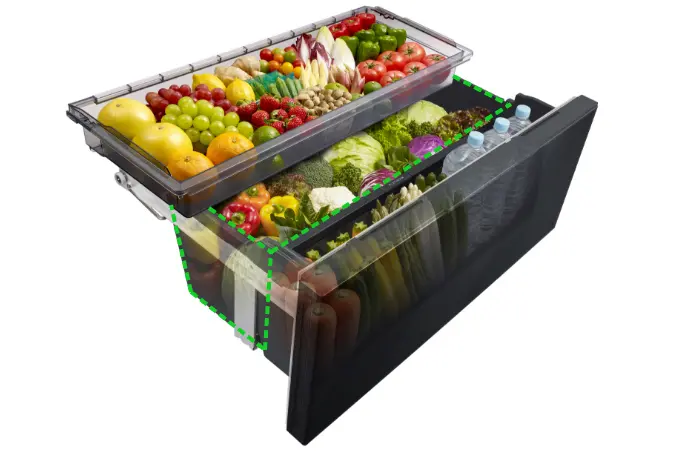
Aero-care Vege Compartment
※Tested by Hitachi.
2020
Recipient of the Inoue Harushige Prize
Organiser: Inoue Harushige Prize Committee
Joint research with Hokkaido University on a platinum catalyst that enhances CO₂ generation capability
Hokkaido University and Hitachi have continuously worked together to develop the
Platinum Catalyst with an improved
carbon dioxide generative capacity and increased ethylene gas decomposition performance by combining
platinum and
ruthenium.
"What is the Inoue Harushige Prize?"
This award recognises outstanding technologies developed and commercialised by
companies based on research results from
universities and research institutions, which contribute to scientific and technological advancement,
economic
development, and social welfare. In fiscal 2020, the prize was presented for the "Development of a
platinum catalyst for
maintaining the freshness of produce" to Professor Fukuoka of Hokkaido University and Hitachi Global
Life Solutions,
Ltd.
By preserving as if letting it "rest," freshness lasts longer
※Tested by Hitachi. Aero-care Vege Compartment is only for
the bottle shelf space.
※Image for illustrative purposes only.
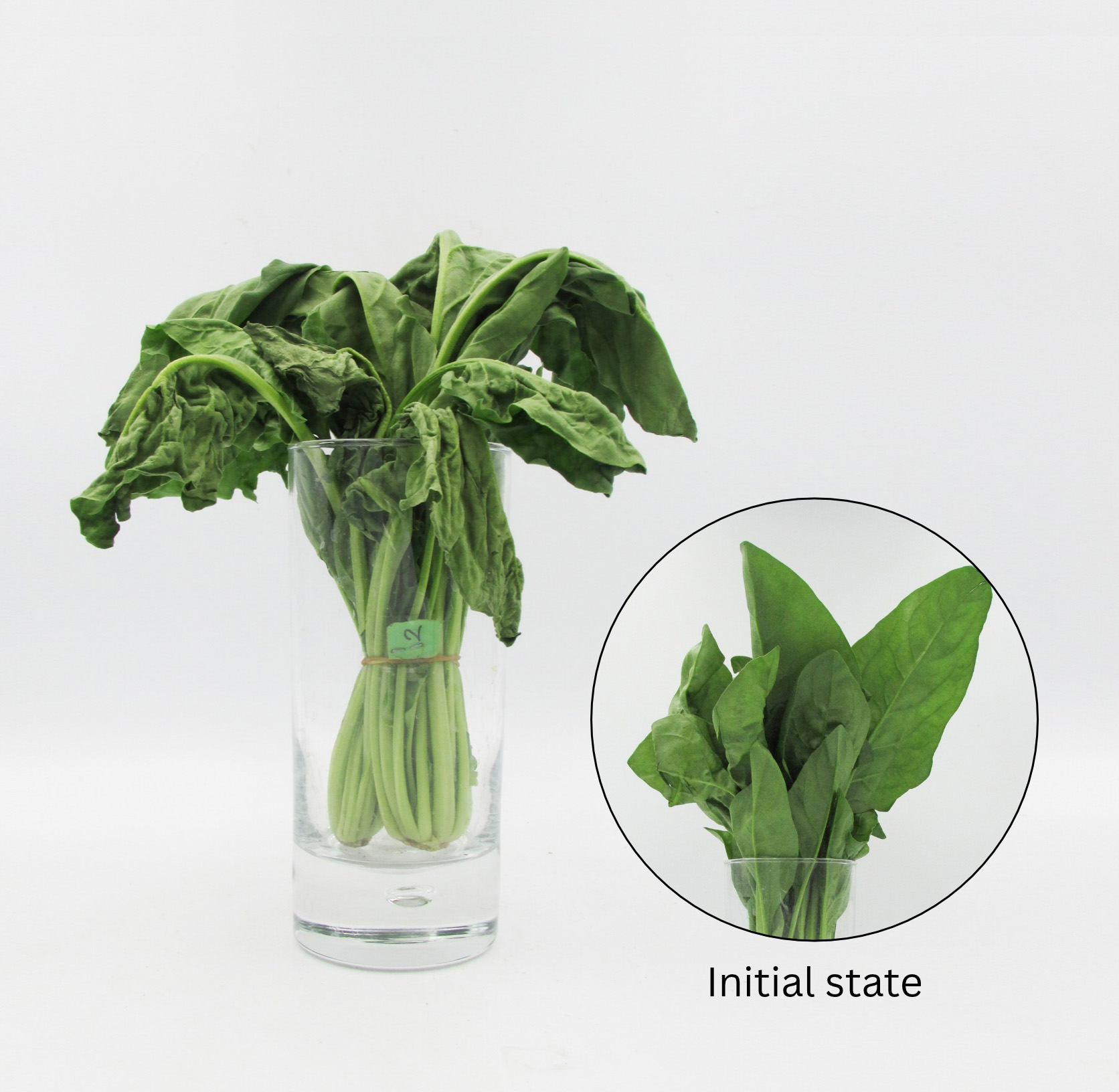
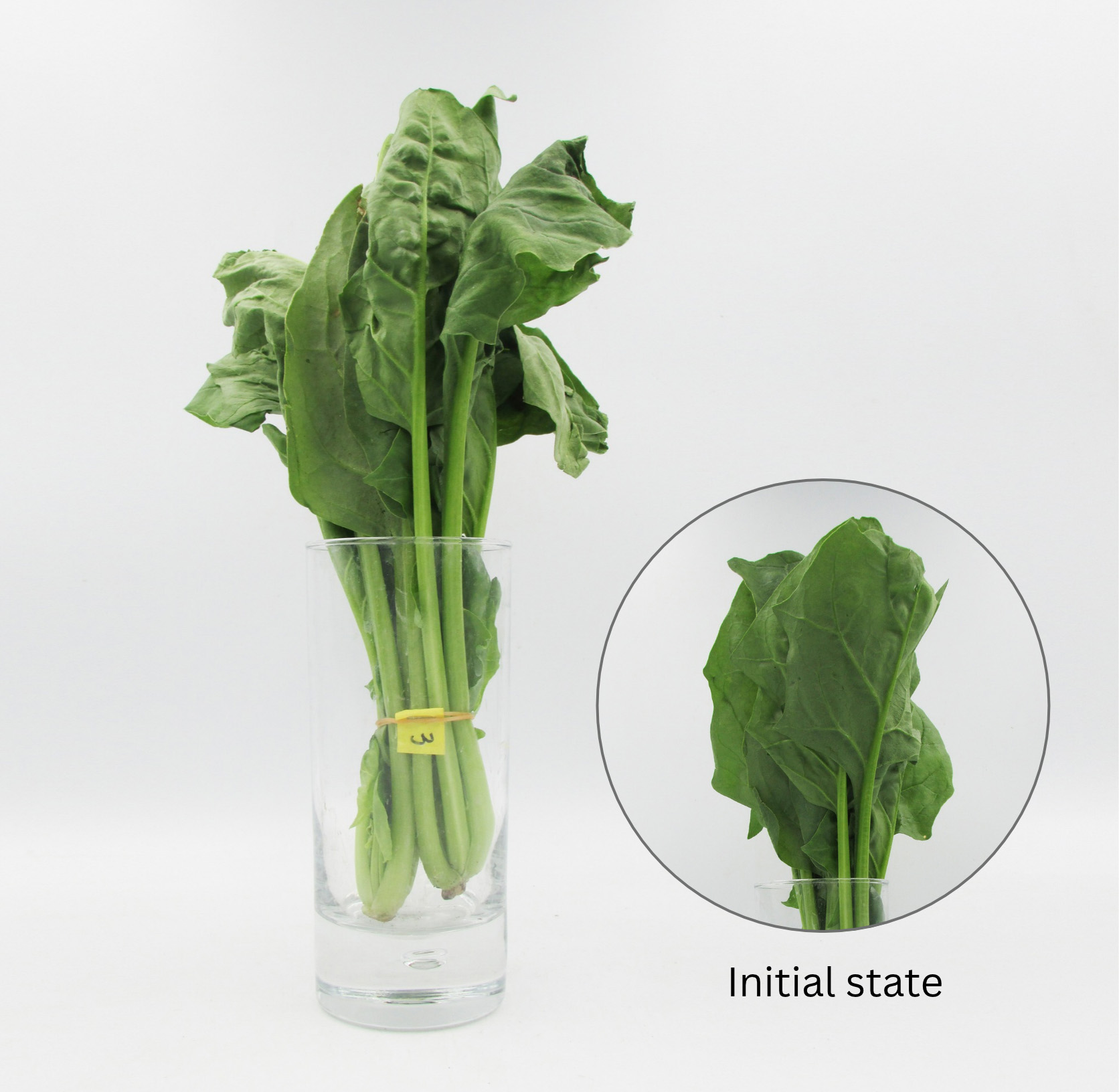
Freshness lasts for about 10 days
Enables bulk shopping with confidence
※Tested by Hitachi. The effect may differ depending on
food types, condition, and quantity.*14
Moisture Retention for
spinach
Approx. 81%
Without Aero-care Vege Compartment
Approx. 90%
With Aero-care Vege Compartment
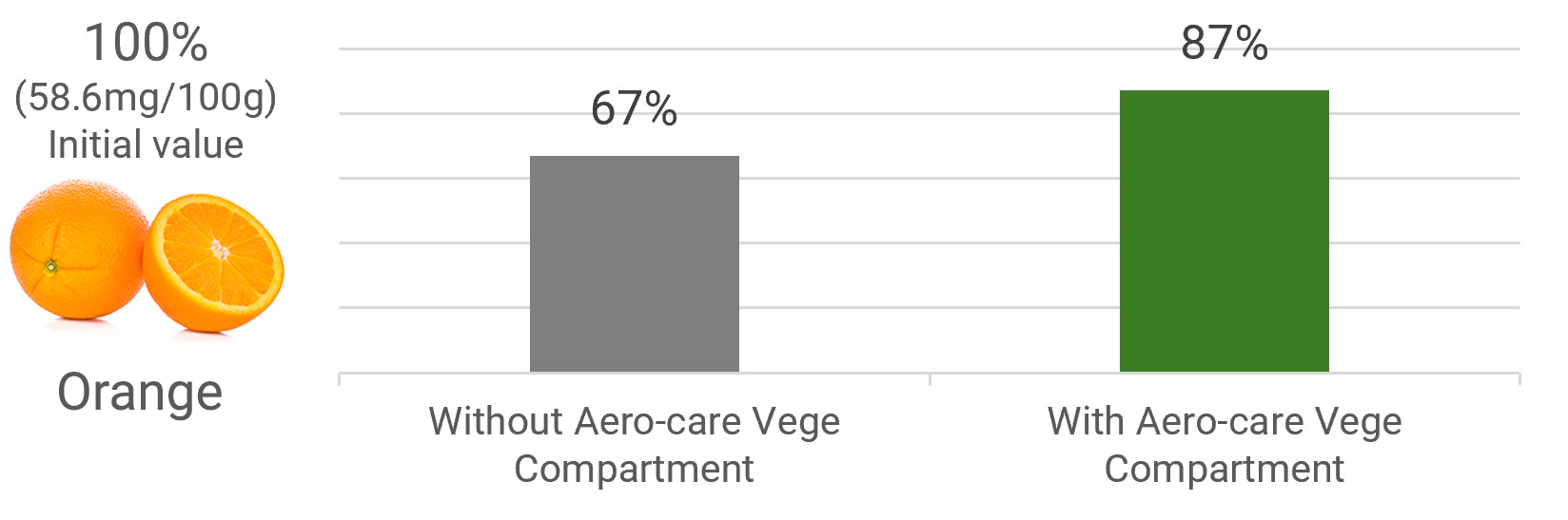
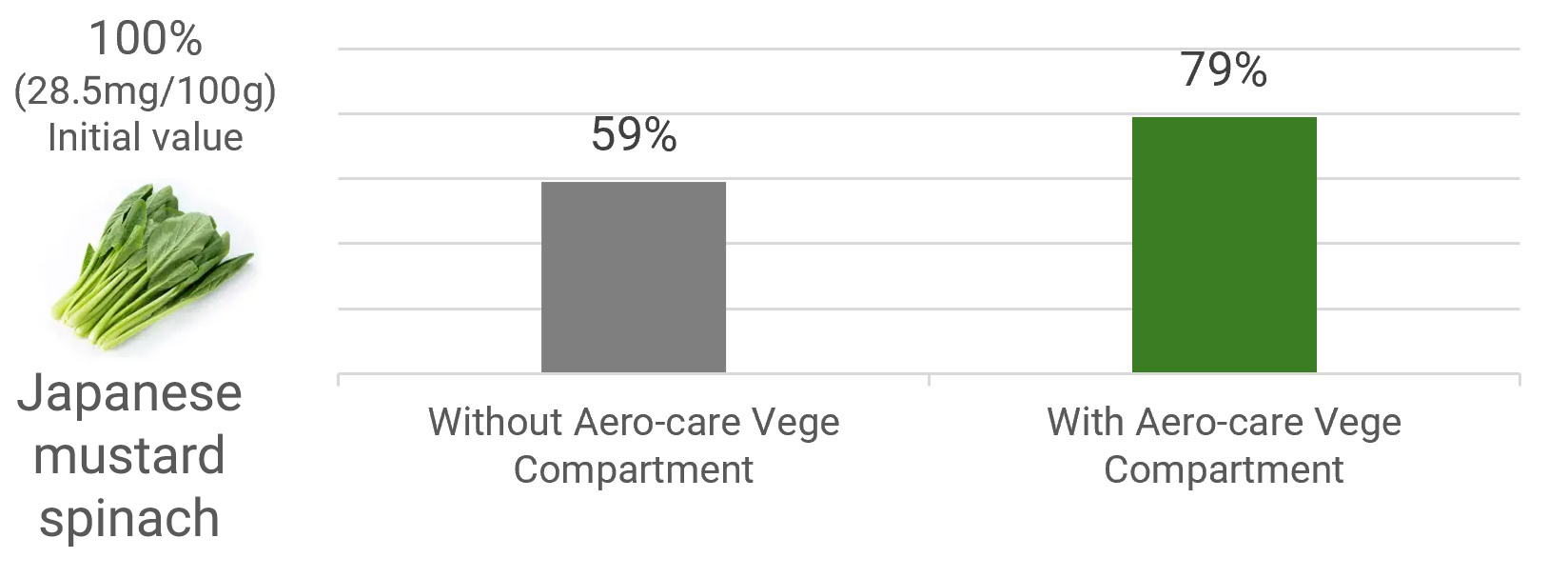
Helps retain vitamin C in fruits and vegetables
※Tested by Hitachi. The effect may differ depending on
food types, condition, and quantity.*15
*14 Tested model for Aero-care Vege Compartment: R-GXCC67T (equivalent performance to R-GW670TV). Tested
model for Without
Aero-care Vege Compartment: R-H54S. Stored for 10 days. Room temperature set at approx. 20℃ and without door
opening/closing. A comparable volume of vegetables (based on compartment capacity) was stored in both models.
*15 Tested model for Aero-care Vege Compartment: R-GXCC67T (equivalent performance to R-GW670TV). Tested
model for Without
Aero-care Vege Compartment: R-H54S. Room temperature set at approx. 20℃ and without door opening/closing. It does
not
have an effect of increasing nutrient content from the initial value.
Note: This feature helps preserve nutrients but does not increase the nutrient content beyond the food's original
value.
Energy Saving
Adapt to your lifestyle
Learns your household usage patterns from door opening/closing status to maintain a
stable temperature and defrosts
during stable periods, like late at night or when you're away.
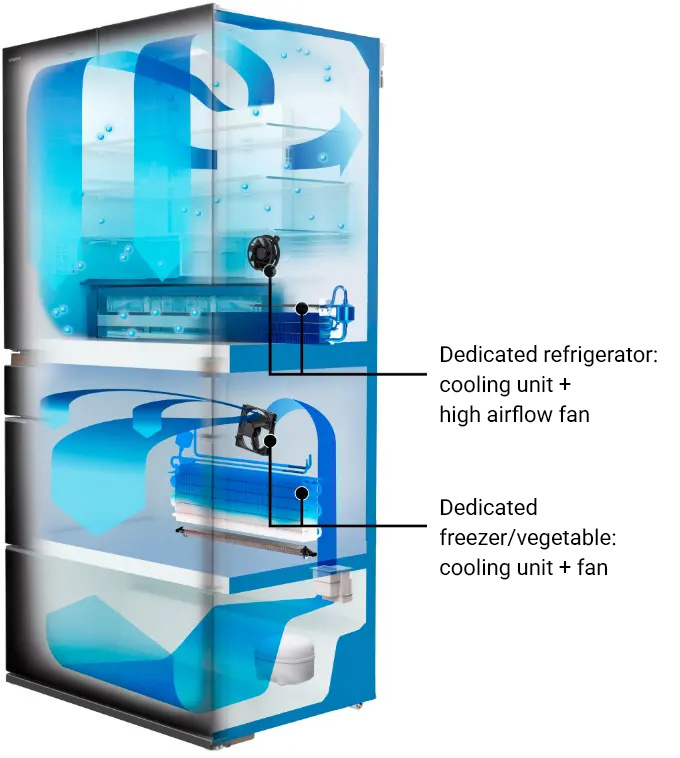
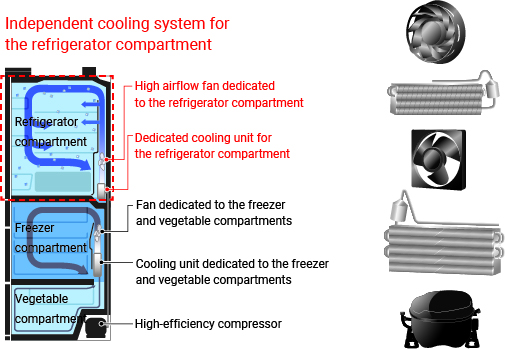
Dual evaporator cooling system
Equipped with two cooling units and fans--one dedicated to the refrigerator
compartment and another for the freezer and
vegetable compartments. By separating the refrigerator compartment, its cooling unit can operate at a
higher
temperature, reducing energy consumption.
※Image for illustration purpose only.
Dual evaporator cooling system
※Image for illustration purpose only.
Easy to Use
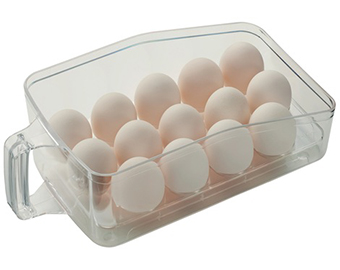
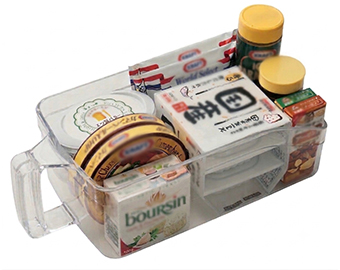
Accessory case
The built-in handle makes it easy to take out, even when storing on the high shelf
Includes an egg holder.
The case can also be used to organize and store small food items together.
Bulk-purchased foods can be neatly organised.
Easy to use and easy to take in and out
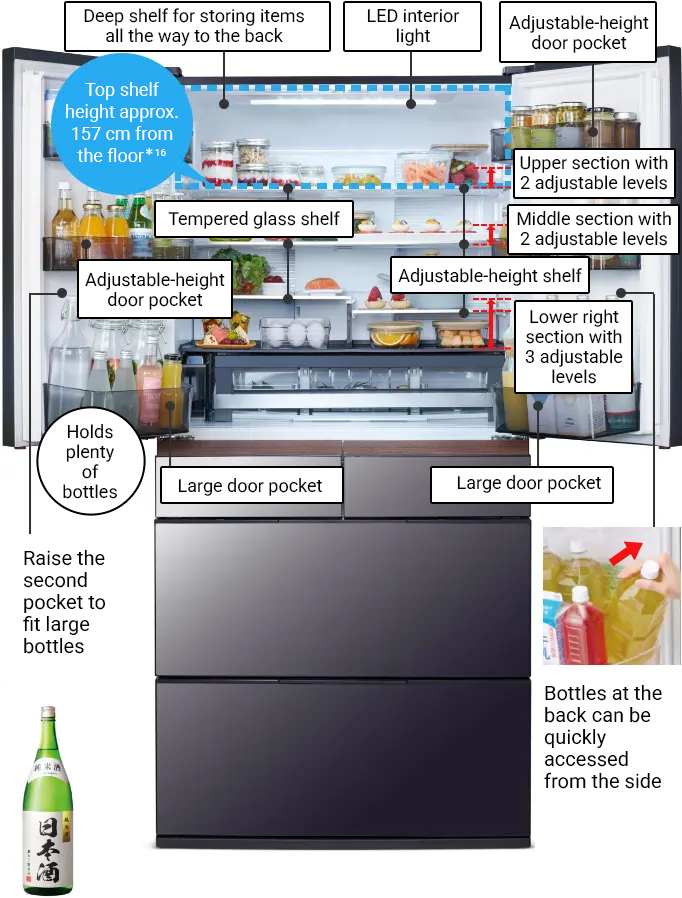
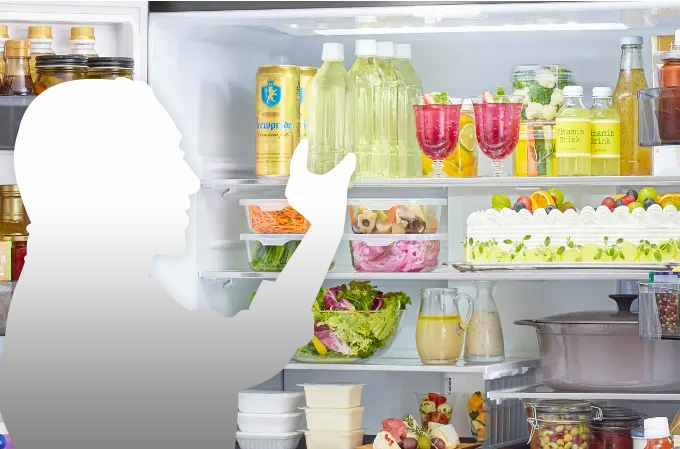
65cm slim depth makes it easy to see and take out
The top shelf can store 500mL plastic bottles upright.
The top shelf can store 500mL plastic bottles upright. By using it together with the
door
pocket, bottles can be stored in large quantities while keeping everything organised.
*16 The shelf set at a lower supporting rail.
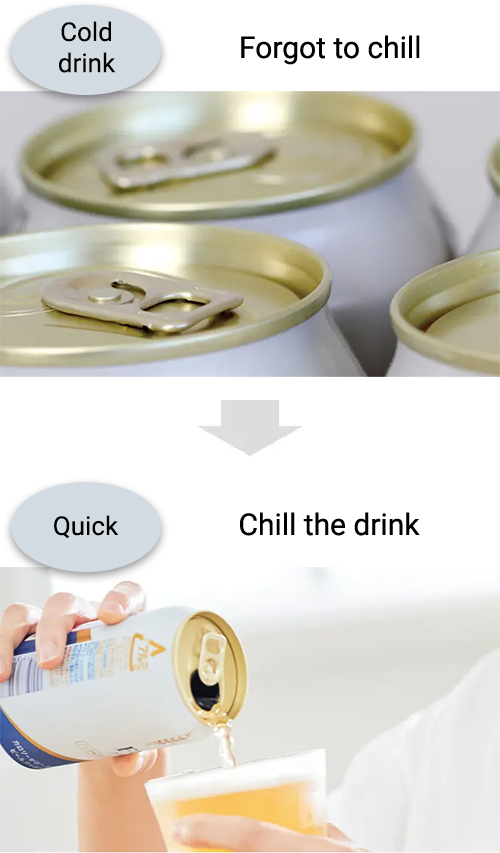
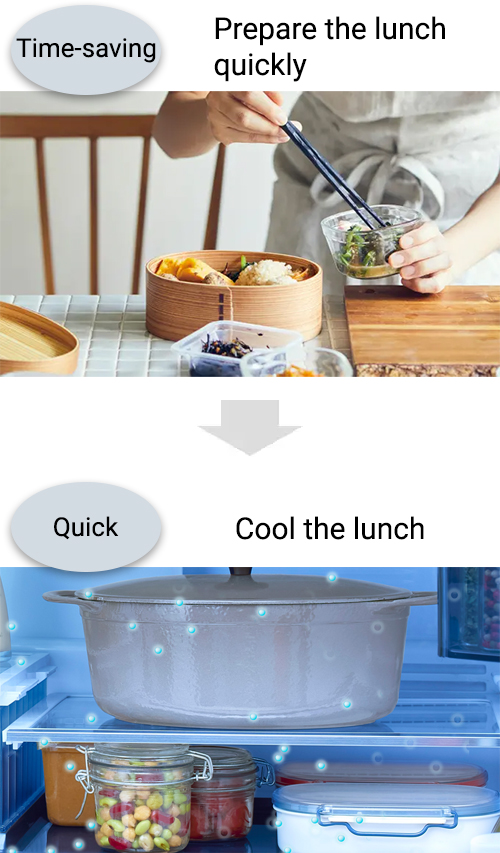
Quick Cooling
Convenient when you need rapid cooling
Increases the cold air flow for a period of time to cool food faster. ※Tested by Hitachi.
※Image for illustrative purposes only.
Set using the "Cooling" button*17
Operating time is approximately 60 minutes after pressing the button. ※Door display and control panel are in English only.
※When storing warm food, allow it to cool to a temperature that can be comfortably
held by hand (approx.50°C or below)
before placing it inside.
※Image shows model R-HXCC62X (equivalent performance to R-GW670TV). Capacity,
dimensions, and design may vary between
R-HXCC62X and R-GW670TV.
*17 (Quick Cooling Mode): By default, Quick Cooling mode is disabled. When activated, the refrigerator's
total power consumption increases by approximately 8%. This mode can operate independently regardless of the
refrigerator's current temperature settings.
The test results described above do not extend the maximum shelf life of food and do not guarantee storage
periods beyond those specified by the food manufacturer.
○ Descriptions and specifications are based on data from model R-GW670TV.
○ Data without specified testing institutions are based on in-house research.

 Search
 Vietnam