
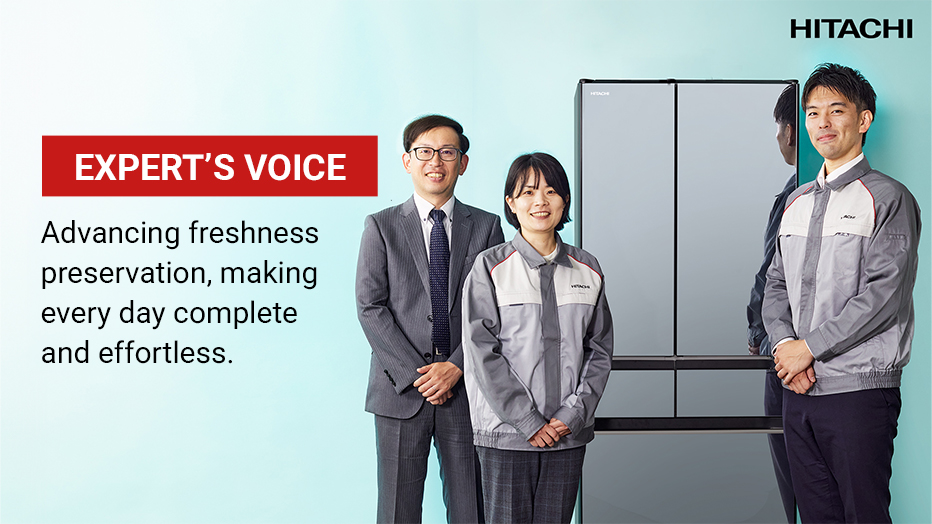
At Hitachi, we believe that a refrigerator is more than a household appliance; it is the foundation of every family's peace of mind. We continually ask ourselves: can food be kept even fresher, and can the user experience become even more effortless? By putting ourselves in our customers' shoes and constantly improving, Hitachi's leading experts are redefining convenience and setting new standards of freshness for more relaxed, flavourful everyday living.

Mr. Ogawa Masanobu(小川 真申)
Deputy General Manager
Ms. Kokubu Mako(國分 真子)
Assistant Senior Engineer
Mr. Hattori Keisuke(服部 圭介)
Assistant Senior Engineer
It is called Delicious Freezing. Put simply, it allows food to be frozen at home automatically and rapidly while preserving its original flavour.
The secret lies in the highly conductive aluminium tray on the first tier of the freezer. It absorbs heat and cools food rapidly, helping prevent large ice crystals from damaging its cellular structure. Even when a warm bowl of rice (approx. 50°C or below) is placed inside, a dedicated intelligent temperature sensor detects it immediately and automatically adjusts the operating mode for optimum freezing.
I was responsible for designing the intelligent sensor control system.
Conventional freezers face two major challenges. The first is a common customer concern: food quality deteriorates after freezing. With meat, for example, conventional freezing often causes drip loss during thawing, taking nutrients and natural flavour with it. To prevent large ice crystals from damaging the cellular structure, food must pass through the maximum ice crystal formation zone (-1°C to -5°C) as quickly as possible.

Aluminium Tray with thermal conductivity that quickly absorbs heat
The second challenge was to improve Quick Freezing, which previously required the user to press a button manually. Our aim was to minimise effort by fully automating the process with an intelligent temperature-sensor system.
To determine the optimum sensor position and control settings, the team carried out countless rigorous tests covering ambient temperature, food placement and the thermal characteristics of different foods. We repeated these trials until the system responded with the required precision.

That's right. Control-system development often consists of quiet improvements that users cannot see. After many trials, we found that stacking food prevented the aluminium tray from performing at its best. We therefore decided to use the full, spacious area of the first tier of the freezer.
With this design, Delicious Freezing not only preserves food effectively; it also makes organisation neater and rapid cooling easier. Despite the challenges, my greatest reward is hearing customers say that the product has made everyday use easier and more convenient than ever.
Chilled compartments have traditionally offered limited space. This is a genuine breakthrough, isn't it?
The Moisture Cooling Solution maintains an ideal low temperature
of approx. 2°C*1 The Whole
Chilling Solution maintains an ideal low temperature of
approx. 2°C
Note: the Moisture Cooling Solution is not applicable to the
door pockets.

Hitachi made the Moisture Cooling Solution possible by installing a dedicated cooling system exclusively for the Refrigerator Compartment.
In conventional refrigerators, all compartments usually share a single evaporator. Its temperature must therefore be set for the freezer, the compartment requiring the lowest temperature. This unintentionally removes moisture from the cold air before it reaches the Refrigerator Compartment.
A dedicated evaporator operates at the optimum temperature and delivers moisture-rich cold air. A powerful fan circulates it evenly, maintaining approx. 2°C*1 throughout the compartment.
That's right. To ensure that every part of the Refrigerator Compartment remained stable at 2°C*1, we carried out countless practical measurements using simulated food samples, checking every shelf and every level.
Low humidity inside refrigerators had previously been accepted as unavoidable. With the Moisture Cooling Solution, however, we had to achieve and maintain an optimum high-humidity environment. This was an entirely new challenge for Hitachi, and many unexpected issues arose. Whenever they did, the entire factory team, not only the Design Department, contributed its knowledge and experience to resolve each technical problem.
Although the feature incorporates highly advanced technology, our priority is still to give customers the easiest, most effortless experience possible. Hitachi will continue to advance preservation technology to support the everyday lives of families.
*1 The temperature of approx. 2°C is a reference food temperature when the ambient temperature is approx. 32°C and the Refrigerator Compartment temperature has stabilised with the Moisture Cooling Solution enabled.

We often tell customers that the Aero-care Vege Compartment gently lulls vegetables into a deep sleep.
Even after harvest, vegetables continue to breathe and release ethylene gas, a natural plant hormone. Although ethylene promotes ripening, it also accelerates ageing and causes produce to wilt. The key to preservation is therefore to slow the respiration process.
Like people, vegetables benefit from a good night's sleep: slower respiration keeps them fresh and crisp.
That's right. At the time, we recognised a significant social need for more effective vegetable preservation. People were not eating enough green vegetables each day, yet food waste caused by spoilage remained alarmingly high.
Hitachi already had pressure-reduction technology for limiting oxygen, but controlling oxygen concentration, which accounts for around 20% of air, was extremely difficult. We therefore shifted our research to carbon dioxide (CO2), a method normally used for industrial preservation. Increasing the CO2 concentration significantly slows vegetable respiration.
At the time, some Vegetable Compartments used photocatalysts to generate CO2, but the process required light. By a fortunate coincidence, Hokkaido University had developed a Platinum Catalyst that decomposed ethylene gas into CO2 at 0°C without light. I immediately thought, 'This is the missing piece for our refrigerators', and contacted the university.

Platinum Catalyst: the key to keeping vegetables fresh for longer
*2 Tested model: R-GXCC67T (equivalent performance to R-GW670TV). The Aero-care Vege Compartment (lower case) was filled with fruits and vegetables and stored for 10 days at an ambient temperature of approx. 20°C, without wrapping and with no door opening or closing. For model R-H54S (without an Aero-care Vege Compartment), an equivalent quantity of fruits and vegetables was tested based on the capacity of the corresponding compartment.
It was not that simple. To keep CO2 from escaping, we needed an extremely airtight structure. Yet that airtightness allowed moisture from the vegetables to accumulate and caused excessive condensation. We nearly gave up because we did not want customers to have to wipe away standing water every day.
After many sleepless nights, we found the answer in a specialised membrane, normally used in dehumidifiers, that can absorb and release moisture as needed.
We tested repeatedly with large quantities of moisture-rich vegetables until condensation was no longer an obstacle. This led to the Moisture Control System, which condenses moisture from the vegetables on dedicated panels and then allows it to evaporate again. The system helps vegetables remain hydrated and crisp for up to 10 days. The difference between vegetables stored in the Aero-care Vege Compartment and those stored in a conventional compartment demonstrates the impact of this breakthrough.
*Tested by Hitachi. The effect may differ depending on food types, condition and quantity. *2

A side-by-side comparison clearly demonstrates the breakthrough performance of this technology.
*2 Tested model: R-GXCC67T (equivalent performance to R-GW670TV). The Aero-care Vege Compartment (lower case) was filled with fruits and vegetables and stored for 10 days at an ambient temperature of approx. 20°C, without wrapping and with no door opening or closing. For model R-H54S (without an Aero-care Vege Compartment), an equivalent quantity of fruits and vegetables was tested based on the capacity of the corresponding compartment.

Since beginning my design career, I have devoted 20 years to refrigerator research and development. Throughout that time, I have believed that preserving food's original freshness is our most fundamental mission and the core strength on which Hitachi refrigerators have built their reputation.
Building on freshness preservation, we recognise that modern lifestyles demand larger capacity and greater convenience to reduce daily kitchen time and effort.


Whether we are developing larger capacity or greater convenience, everything ultimately serves one purpose: giving customers the greatest possible sense of Ease.
Ease means ample storage without calculation, freezing food while warm, keeping leafy vegetables fresh and turning the entire Refrigerator Compartment into an ideal chilled space.
We will create refrigerators designed around each customer's Ease.
At Hitachi, we believe the pinnacle of technology lies in its silent operation, where every smart solution seamlessly blends into your life to deliver absolute ease. Let HitachiAt Hitachi, we believe that technology reaches its highest form when it works quietly in the background, with intelligent solutions blending seamlessly into everyday life to deliver complete Ease. Let Hitachi Made in Japan refrigerators elevate your kitchen and bring you a distinctive standard of freshness every day.
©Arcelik Hitachi Home Appliances Sales Vietnam Co., Ltd.
. All rights reserved.

 Search
 Vietnam