
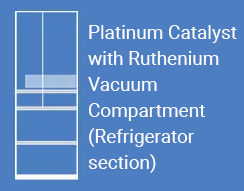
Preserves nutrients and moisture for delicious storage.
※Tested by Hitachi. Fresh food was used in the test.
※Among non-CFC household refrigerators in Japan, as of January 2026
※Tested by Hitachi.
A vacuum pump and pressure-resistant structure remove air inside the compartment. With an environment of approx. 0.8 atm and about -1°C*2, oxidation is suppressed to preserve food deliciously.
※Tested by Hitachi.
One cause of food drying is direct airflow used for cooling. This compartment uses indirect cooling and a sealed structure to reduce drying.
※Tested by Hitachi.
Adopts a platinum catalyst that decomposes odour components from meat and fish into carbon dioxide and water. The CO₂ suppresses enzyme activity on the food surface, helping maintain freshness.
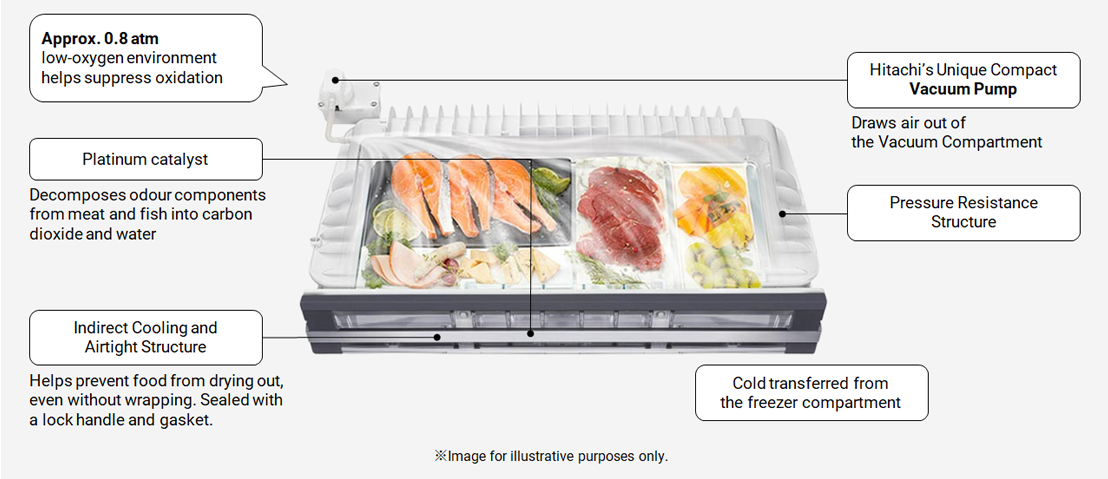
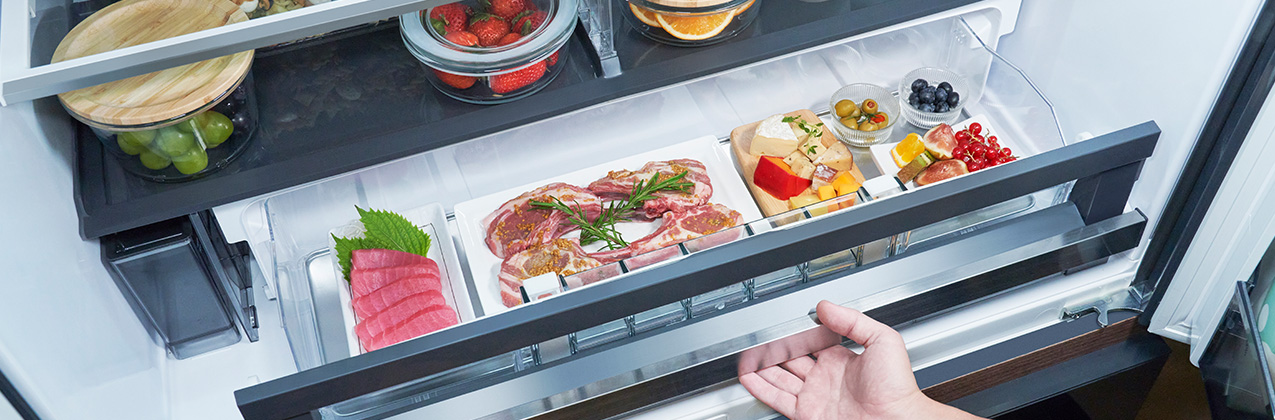
One of the causes of food deterioration is oxidation. Although vacuum preservation technology exists to prevent oxidation, creating an airtight environment at home is not easy. Vacuum Compartment helps reduce oxidation of food by lowering the amount of oxygen inside the compartment.
The temperature range from 0°C to the freezing point of food is called the "ice temperature zone." Utilizing this range offers various benefits. For example, fish has a freezing point of about −2°C, so storing it between 0°C and −2°C keeps it fresh without freezing.
Helps maintain food freshness in a vacuum environment*1 which prevents oxidation and supports nutrient retention.
*Does not extend best-before or expiration dates.
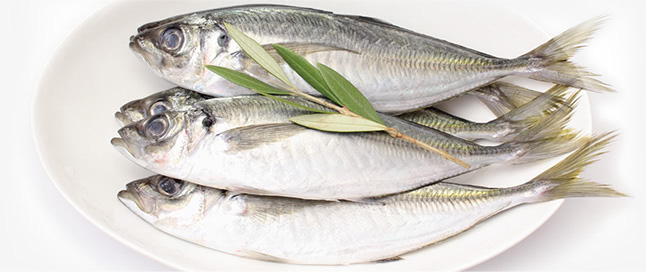
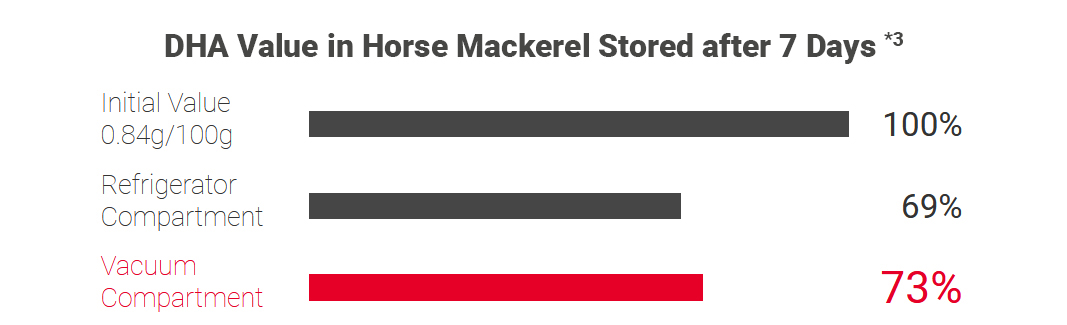
*2 Tested by Hitachi. Tested Model: R-GWC670TC. (Equivalent performance to R-GW670TV)
The
effect may
differ depending on types or freshness of food stored and does not extend to best-before and expiration
dates.
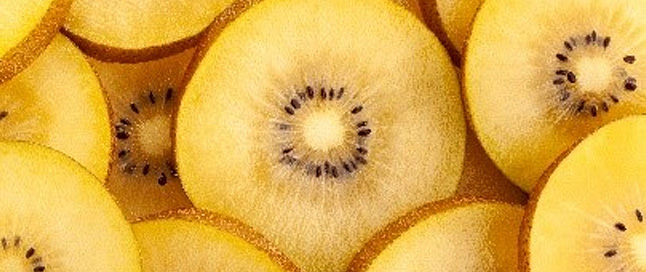
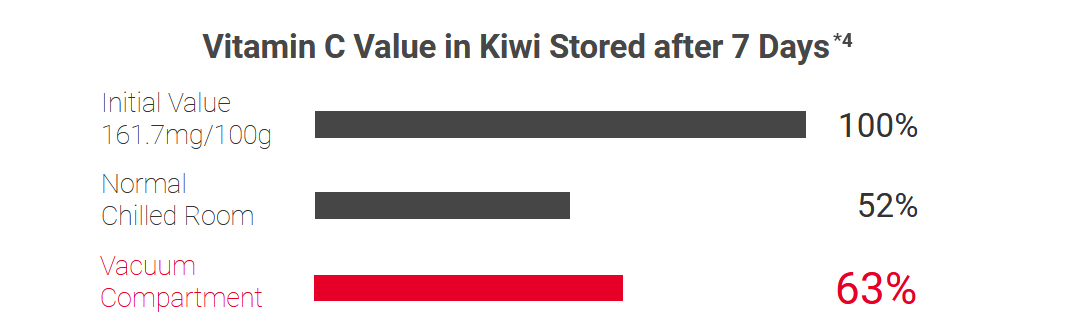
*2 Tested by Hitachi. Tested Model: R-GWC670TC. (Equivalent performance to R-GW670TV). Tested
model for
normal chilled room: R-K40H.
The effect may differ depending on types or freshness of food stored and
does not extend
to best-before and expiration dates.
*1 Vacuum is a state of lower pressure than atmospheric pressure.
The pressure inside vacuum
compartment
is approximately 0.8 atmospheres, which is lower than atmospheric pressure, so Hitachi calls it a vacuum. This
value
represents the average pressure inside the compartment when operated for 3 days without opening or closing
the door.
※Tested by Hitachi. The effect may differ depending on food types, condition, and quantity.*3 *4
Protecting the freshness of food without freezing at approximately -1℃ . No freezing or wrapping required. Enjoy fresh ingredients.

Initial Value: 10.5%
Vacuum Compartment: 19.5%

Initial Value: 42.4%
Vacuum Compartment: 59.9%
※Tested by Hitachi. The effect may differ depending on food types, condition, and
quantity.*5
*5 Tested by Hitachi. Tested Model for vacuum compartment: R-GWC670TC (Equivalent performance to
R-GW670TV) K-value is an
indication of freshness. The lower the value, the fresher the item. K-value of 20% or higher is not suitable for
eating
raw and K-value of 60% or higher is not suitable for consumption. The effect may differ depending on types or
freshness
of food stored and does not extend to best-before and expiration dates.
Tuna Stored after 3 Days*6
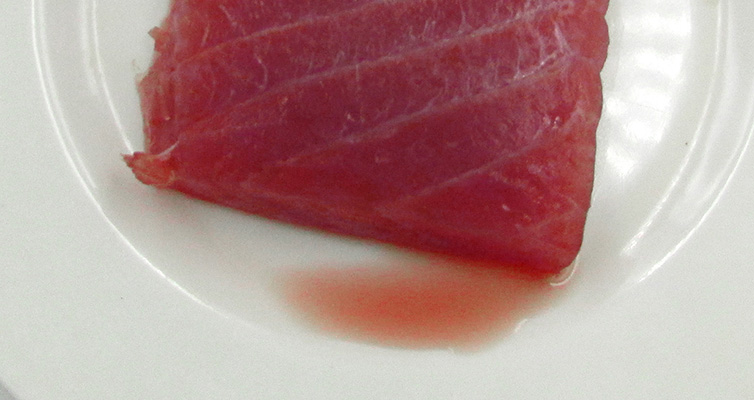
Drip amount 1.73g/100g
Freezer (natural thawing in 3 hours)
*6 Tested by Hitachi. The effect may differ depending on food types, condition, and quantity. Comparison of storage for 3 days between Vacuum Compartment (-1°C setting, unwrapped) of R-GWC670TC (equivalent performance to R-GW670TV) and freezer compartment (lower freezer, mid case, wrapped), then naturally thawed at room temperature (approx. 20°C) for about 3 hours. Room temperature set at approx. 20℃ and without door opening/closing.
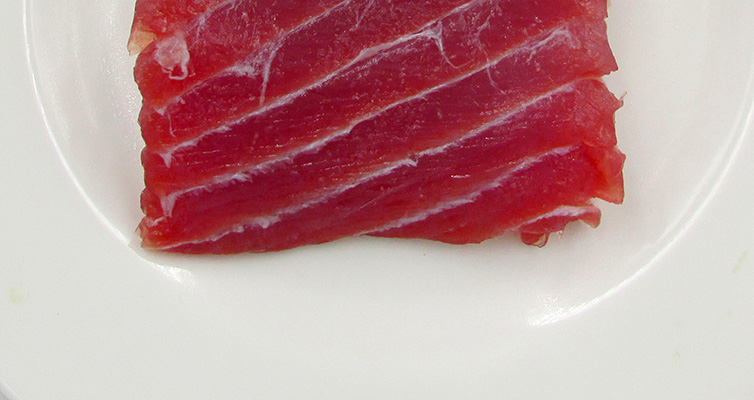
Drip amount 0.51g/100g
Vacuum Compartment (-1°C)
※Tested by Hitachi. The effect may differ depending on food types, condition, and quantity.*6
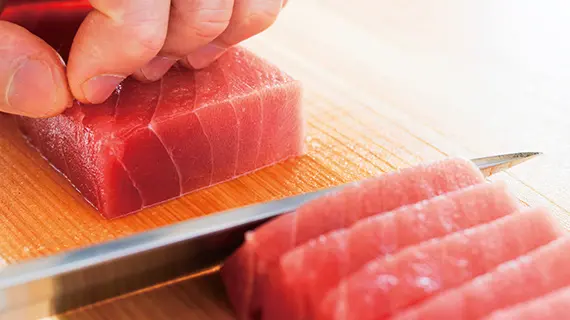
No thawing required, so you can start cooking right away. Unused portions can be quickly returned, allowing efficient use with minimal waste.
*The above claims do not extend the best-before or use-by date, nor do they guarantee the labelled
storage period.
*1 Vacuum is a state of lower pressure than atmospheric pressure. The pressure inside vacuum compartment
is
approximately 0.8 atmospheres, which is lower than atmospheric pressure, so Hitachi calls it a vacuum. This value
represents the average pressure inside the compartment when operated for 3 days without opening or closing the
door.
*2 When the room temperature is approx. 32°C and the refrigerator compartment temperature has stabilized,
the
temperatures shown are approximate food temperatures.
*3 Comparison of storage for 7 days between Vacuum Compartment (-1°C setting, unwrapped) of R-GWC670TC
(equivalent
performance to R-GW670TV) and refrigerator compartment of R-GWC670TC (■■ setting, wrapped). Room temperature set at
approx. 20℃ and without door opening/closing.
*4 Comparison of storage for 7 days between Vacuum Compartment (-1°C setting, peeled and wrapped) of
R-GWC670TC
(equivalent performance to R-GW670TV) and chilled compartment of R-K40H (peeled and wrapped). Room temperature set
at
approx. 20℃ and without door opening/closing.
*5 Tested Model for vacuum compartment: R-GWC670TC (Equivalent performance to R-GW670TV) K-value is an
indication of
freshness. The lower the value, the fresher the item. K-value of 20% or higher is not suitable for eating raw and
K-value of 60% or higher is not suitable for consumption. The effect may differ depending on types or freshness of
food
stored and does not extend to best-before and expiration dates.
*6 Comparison of storage for 3 days between Vacuum Compartment (-1°C setting, unwrapped) of R-GWC670TC
(equivalent
performance to R-GW670TV) and freezer compartment (lower freezer, mid case, wrapped), then naturally thawed at room
temperature (approx. 20°C) for about 3 hours. Room temperature set at approx. 20℃ and without door opening/closing.
○ This page introduces the features of the R-GW670TV.
○ Explanations are based on the R-GW670TV.
○ Data without specified testing authorities are based on in-house testing.
©Arcelik Hitachi Home Appliances Sales Vietnam Co., Ltd.
. All rights reserved.

 Search
 Vietnam